
Most of the best detecting ground is private: farm fields, old house lots, pasture nobody has dug in a century. Getting onto it takes a conversation and a signature. Below is a free permission agreement you can print or copy, what each part is for, and how to ask so the answer is yes more often.
Download the printable permission form (PDF). It is one page, US Letter size, and prints fine on A4.
Why get permission in writing
- It is the difference between a guest and a trespasser. On private land, detecting without the owner's permission is trespassing.
- It settles who owns the finds. Who owns a find depends on local law, and in many places it is the landowner by default. Agreeing up front avoids an argument over the one good find of the year.
- It protects a Treasure reward. In England, Wales and Northern Ireland, a reward can be reduced or not paid at all if you were detecting without the landowner's permission.
- It answers questions for you. A neighbor, a tenant or a police officer asking what you are doing there gets a signed page instead of your word.
- It survives changes. Land gets sold, inherited and leased. A dated signature shows who agreed and when.
What a permission letter should cover
- Names and phone numbers of both of you
- The property, the areas you may search, and the ones that are off limits, such as crops, livestock, lawns and gardens
- Start and end dates, or “until either of us ends it”
- Whether you call or text before each visit
- How you will look after the land: every hole filled, gates left as found, rubbish carried out
- What happens with finds, including an agreed split for anything valuable
- In England, Wales and Northern Ireland, how a Treasure reward will be shared
- Who is responsible for your safety
- Both signatures and the date
Free metal detecting permission form
Copy it into a document, or print the PDF and fill it in by hand. Cross out anything that does not apply, and keep a signed copy each.
METAL DETECTING PERMISSION AGREEMENT
Landowner: ____________________ Phone: ____________
Property address or description: ____________________
Detectorist: ____________________ Phone: ____________
Email: ____________________
1. Permission. The landowner gives the detectorist permission to use a metal detector on the property above and to dig small holes to recover targets.
2. Where. Allowed areas: ____________________. Areas to avoid (crops, livestock, lawns, gardens): ____________________.
3. When. From ________ to ________ (or until either party ends it). The detectorist will call or text before each visit: yes / no.
4. Care of the land. Every hole will be filled and turf replaced. Gates will be left as found. Rubbish that is dug up will be taken away.
5. Finds. All finds will be shown to the landowner. Agreed arrangement for finds of value: ____________________.
6. Treasure (England, Wales and Northern Ireland only). Any find that may be treasure will be reported as the law requires. Any reward will be shared: landowner ______ detectorist ______.
7. Safety. The detectorist is responsible for their own safety and equipment while on the property.
8. Ending. Either party may end this permission at any time.
Landowner signature: ____________________ Date: ________
Detectorist signature: ____________________ Date: ________
How to find out who owns the land
- In the US, most county assessor or county GIS websites have a parcel map that shows who owns each lot. Search for your county's name plus “parcel viewer”.
- In England and Wales, HM Land Registry sells a copy of the title register for most land, and it names the owner.
- Farmland is often rented. The person working the field may be a tenant. Talk to them about the crops, and get the signature from whoever owns the land.
- Ask around. Neighbors, the local historical society and the farm supply store usually know who owns what.
How to ask a landowner
Go in person, in daylight, and not at mealtimes. Farmers are busiest at planting and harvest, so the weeks after harvest and the winter are the best time to ask. Keep it short, and say three things: who you are, what you would like to do, and how you look after the land.
“Hi, I'm [name], I live over in [town]. My hobby is metal detecting, mostly looking for old coins and things people lost. I'd love to try your [field]. I dig small, neat holes, fill every one, and I'll show you everything I find. Would that be all right?”
- Bring the form already filled in with your details, so saying yes takes one signature.
- Bring a few finds or photos of them. People are curious, and an old button or coin explains the hobby better than words.
- If they hesitate, make it smaller. Offer one short visit, or one corner of one field, and a call before you come.
- Take no gracefully. Thank them and leave your number. People sometimes change their minds once they have seen you around.
Asking by letter or email
When you cannot knock, write a short letter: who you are, where you live, which land you mean, how you look after it, how finds are shared, and your phone number. Enclose the form ready to sign, and a stamped envelope if you are posting it.
After the visit
- Show every find, the junk included. Landowners are often curious about what has been in their ground.
- Leave the land better than you found it. Holes filled, turf back, rubbish gone.
- Say thank you, in person or with a short note, and offer them anything they would like to keep.
- Report what the law requires. In England, Wales and Northern Ireland, possible treasure must be reported to the coroner within 14 days. In England and Wales, the Portable Antiquities Scheme also records other finds.
- Renew before it expires. A phone call a few weeks ahead keeps a permission alive.
Keeping track of your permissions
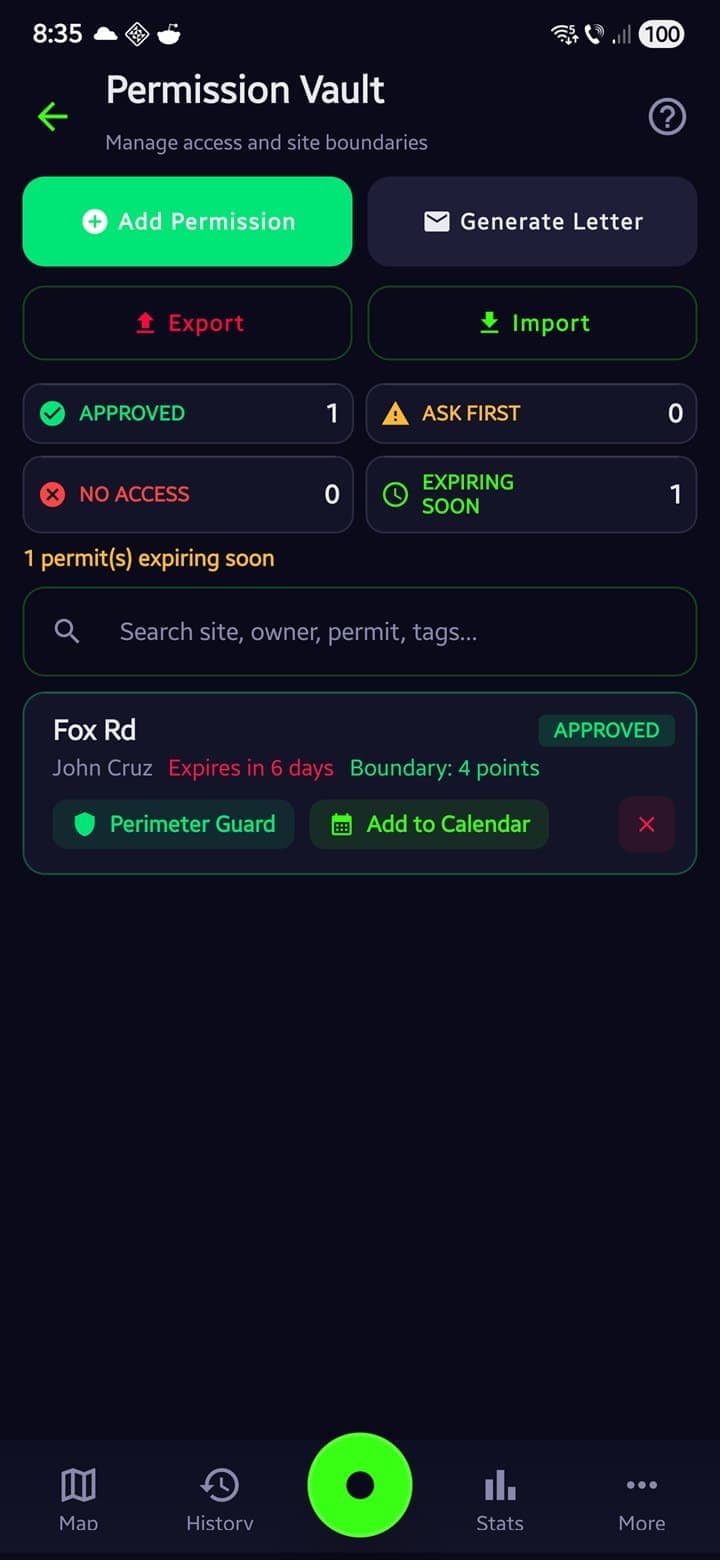
With more than a few permissions, the details slip: which fields are allowed, who asked you to call first, which one runs out in March. SweepTrack Pro's Permission Vaultstores each landowner's name, contact, status and expiry date, draws the boundary on the map, and adds the expiry date to your calendar. With Pro it also generates the request letter and a thank-you letter as PDFs, the landowner can sign on your phone screen, and Perimeter Guard vibrates when you get close to the boundary. The free plan holds one permission.
Common questions
Is verbal permission enough?
It can be, but it is easy to forget or dispute, and it records nothing about finds. Writing it down protects both of you.
Can a tenant give permission?
A tenant farmer controls the crops but may not have the right to let you dig. Ask the tenant and get the owner's signature too.
Do I need permission on public land?
Usually, and it works differently: parks departments, state rules and permits. On US federal land, removing artifacts more than 100 years old without a permit breaks the Archaeological Resources Protection Act. See the US rules and the UK rules.
Does a signed letter make everything legal?
It proves the landowner agreed. It does not override the law, so protected sites, scheduled monuments and cemeteries stay off limits whatever the owner says.
Should I offer the landowner a share?
Many detectorists offer a split on anything valuable, and landowners appreciate being asked. Whatever you agree, write it in section 5.
General information, not legal advice. Laws on trespass, finds and treasure differ by country and state, so check the rules where you detect.